
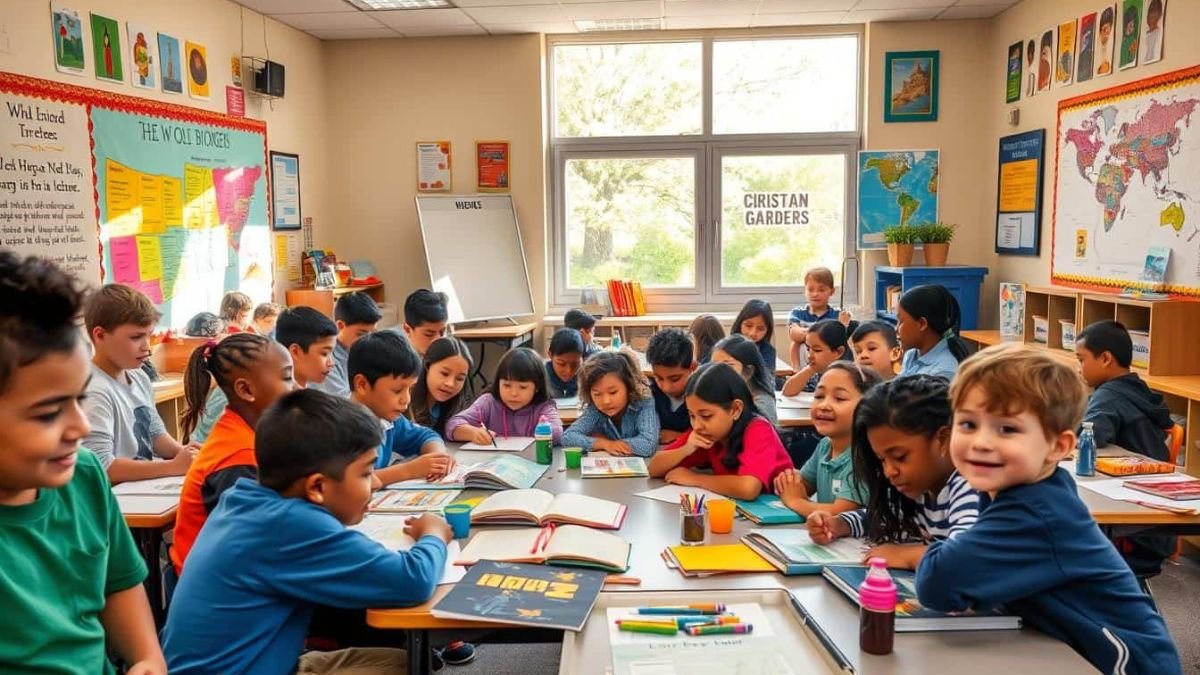
The education system in Christian schools is not limited to textbooks; it strives to guide the child’s entire life. Here, academic learning is integrated with faith, ethics, and life values. Christian schools believe that the purpose of education is not merely to achieve good grades in exams, but to cultivate individuals who embody values such as truth, compassion, honesty, and responsibility. Therefore, the academic approach in these schools is balanced, educating the mind, heart, and soul.
Christian School Curriculum: A Balance of Knowledge and Faith
The curriculum in Christian schools is generally designed according to national or international educational standards. Subjects like mathematics, science, languages, social sciences, computer science, and arts are taught with the same rigor as in any other good school. The difference lies in how these subjects are taught, emphasizing the responsible use of knowledge. For example, while teaching science, the beauty of nature and God’s creation are discussed, and while teaching history, moral decisions and their consequences are explored. In this way, the curriculum empowers children to think critically, understand, and make sound judgments.
Special Emphasis on Academic Standards and Quality
Christian schools do not compromise on academic standards. Many Christian schools are affiliated with recognized boards and undergo regular academic evaluations and inspections. The qualifications of teachers, teaching methodologies, and student performance are constantly monitored. The benefit of small class sizes allows teachers to provide individual attention to each student. This not only improves the quality of education but also allows for the timely identification and correction of students’ weaknesses.
Teaching Methodology: Education for Understanding, Not Just Rote Learning
The teaching methodology in Christian schools encourages children to understand and ask questions, rather than simply memorizing information. Teaching is conducted through classroom discussions, project work, group activities, and practical examples. Teachers encourage children to express their opinions freely and teach them to respect diverse perspectives. This approach builds confidence in children and prepares them for real-life challenges.
Character Building and Academic Development Go Hand in Hand
In Christian schools, equal emphasis is placed on character building alongside academic education. Here, children are taught that honesty, hard work, discipline, and compassion are not just words, but ways of life. Extracurricular activities, prayer meetings, and service programs instill a sense of responsibility towards society in children. When education and character development go hand in hand, children become not only good students but also good human beings.
Evaluation System and Student Outcomes
In Christian schools, student evaluation is not limited to exam scores. Children’s understanding, behavior, participation, and effort are also valued. Regular tests, projects, assignments, and teacher feedback provide a holistic picture of the child’s progress. The positive result is that children begin to see learning not as a burden, but as a natural part of life. Regarding academic results, many students from Christian schools perform exceptionally well in higher education and competitive examinations.
Co-curricular Activities and Holistic Development
Along with academic success, Christian schools also emphasize the all-round development of children. Activities such as sports, music, drama, art, and community service provide children with opportunities to discover their talents. These activities develop skills such as teamwork, leadership, and time management in children. This helps children become balanced and self-reliant not only in the classroom but in every aspect of life.
The Role of Parents and Partnership with the School
Christian schools view education as a partnership where the school and parents work together to shape the child’s future. Regular meetings, progress reports, and open communication strengthen this process. When the home and school share the same values, the child receives clear guidance and their confidence grows. This is why many parents consider Christian schools a safe and positive option for their children.
Preparing for the Future: Education That Lasts a Lifetime
The academic education in Christian schools prepares children not just for the next exam, but for their entire lives. Here, children are taught how to use knowledge for the benefit of others and how to choose the right path even in difficult situations. When strong academic foundations are combined with moral values, children become responsible citizens of society.
Conclusion: A Strong Foundation of Balanced Education
Ultimately, the academic system of Christian schools creates a balanced relationship between curriculum, standards, and outcomes. Here, education is not merely a means of building a career, but a way of giving meaning to life. If a parent desires an education for their child that teaches values and character alongside knowledge, Christian schools can prove to be a strong and reliable academic option.
